Finding your first job after college can feel confusing. You may have a degree, some basic skills and a good academic record, but still not know where to start looking for jobs, which companies to apply to, how to make a resume or how to prepare for interviews.
The good news is that you do not need years of experience to start your career. As a fresher, your focus should be on showing employers that you have the right basic skills, a willingness to learn and the ability to contribute to the role.
In 2026, freshers can search for jobs through company career pages, job portals, professional networking platforms, government employment services, internships, referrals and direct applications. The important part is not simply applying to hundreds of jobs. It is applying to the right jobs with a relevant resume and proper preparation.
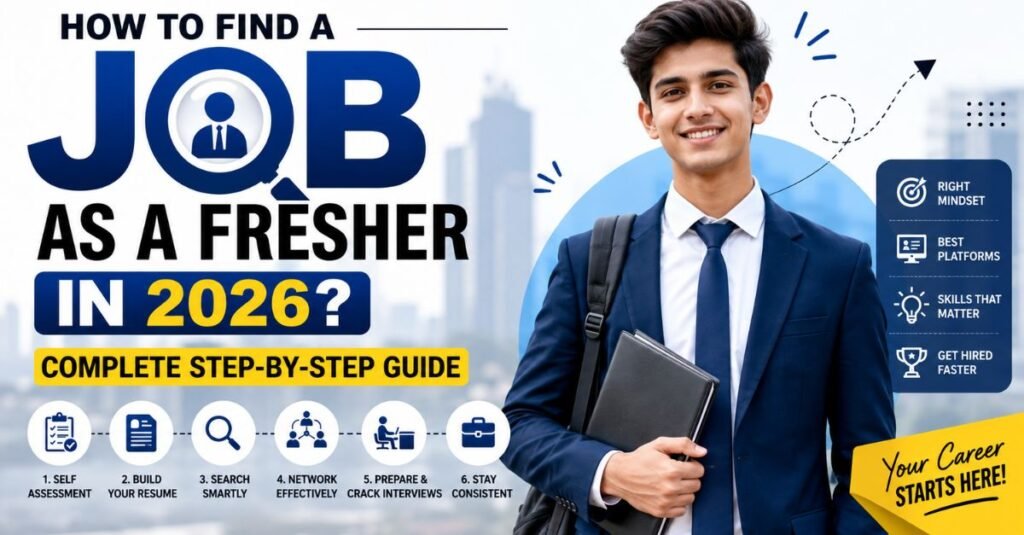
This complete guide explains how to find a job as a fresher in India, from choosing a career path and preparing your resume to finding genuine vacancies, applying correctly, preparing for interviews and avoiding job scams.
Table of Contents
- Understand What Type of Job You Want
- Check Whether You Are Actually a Fresher
- Identify Your Skills
- Choose the Right Job Role
- Learn the Skills Employers Want
- Create a Professional Resume
- Make Your Resume ATS-Friendly
- Create a Strong LinkedIn Profile
- Create Profiles on Job Portals
- Search Jobs Using the Right Keywords
- Apply Through Company Career Pages
- Use Job Portals Properly
- Use Government Job Platforms
- Look for Internships
- Use Employee Referrals
- Build a Professional Network
- Use College Placement Opportunities
- Create a Portfolio
- Apply Even If You Do Not Meet Every Requirement
- Customise Your Resume for Each Job
- Keep Track of Your Applications
- Prepare for Interviews
- Prepare for Aptitude Tests
- Prepare for Technical Interviews
- Prepare for HR Interviews
- Follow Up After Applying
- Understand Job Offers Before Accepting
- Identify Fake Job Opportunities
- Mistakes Freshers Should Avoid
- Create a Daily Job Search Routine
- 30-Day Job Search Plan
- Final Checklist
- Frequently Asked Questions
1. Understand What Type of Job You Want
Before opening a job portal and applying randomly, first decide what type of work you want.
Many freshers make the same mistake: they search for “fresher jobs” without deciding what kind of career they actually want.
For example, a BCA graduate could look for:
- Software Developer
- Web Developer
- QA Tester
- Technical Support Executive
- Data Analyst
- Business Analyst
- IT Support
- Application Support
- Junior Developer
A B.Com graduate might consider:
- Accounts Executive
- Finance Associate
- Banking Operations
- Business Operations
- Customer Support
- Sales Executive
- MIS Executive
A graduate with strong communication skills could explore:
- Customer Support
- Inside Sales
- Business Development
- Recruitment
- Content Writing
- Operations
- Digital Marketing
Why choosing a role matters
If you apply to 20 completely different types of jobs, your resume may not look relevant to any of them.
Instead, select one primary career direction and one or two related roles.
For example:
Primary: Data Analyst
Related: MIS Executive, Business Analyst Intern
This makes your job search more focused.
2. Check Whether You Are Actually a Fresher
The meaning of “fresher” can vary between companies.
You may be considered a fresher if you:
- Recently completed your degree
- Have no full-time professional experience
- Have only academic project experience
- Have completed internships but no full-time job
- Are changing from education to your first professional role
Some companies also advertise positions as 0–1 years, 0–2 years or entry-level.
Therefore, do not search only for the word “fresher”.
Also search for:
- Entry Level
- Graduate
- Junior
- Trainee
- Associate
- Graduate Engineer Trainee
- Management Trainee
- Software Trainee
- Junior Developer
- Apprentice
- Internship
- Internship to Full-Time
This can significantly increase the number of relevant opportunities you discover.
3. Identify Your Skills
Before applying, make a list of everything you can actually do.
Divide your skills into three categories.
Technical Skills
Examples:
- Java
- Python
- JavaScript
- SQL
- Excel
- Power BI
- HTML
- CSS
- React
- Git
- AutoCAD
- Tally
Soft Skills
Examples:
- Communication
- Teamwork
- Problem-solving
- Time management
- Presentation
- Adaptability
- Critical thinking
Practical Experience
This is particularly important for freshers.
Your practical experience can include:
- College projects
- Internships
- Freelance work
- Personal projects
- Hackathons
- Open-source contributions
- Academic research
- Volunteer work
- Certifications with practical projects
Do not think that “I have no experience” means you have nothing to show.
You may not have professional experience, but you can still demonstrate what you can do.
4. Choose the Right Job Role
One of the biggest reasons freshers struggle with job searching is applying for jobs that do not match their background.
For example, if you know Python, SQL and Power BI, searching only for “software engineer” may not be the best strategy.
You could also search for:
- Data Analyst Fresher
- Junior Data Analyst
- Business Analyst
- MIS Analyst
- Reporting Analyst
- Data Intern
- Analytics Intern
Similarly, if you know JavaScript and React, search for:
- Frontend Developer
- React Developer
- Junior Web Developer
- Frontend Intern
- Software Developer Trainee
- Web Development Intern
Create a job-role list
Make a simple list:
Target Role 1: Data Analyst
Target Role 2: MIS Analyst
Target Role 3: Business Analyst Intern
Now your job search becomes much more focused.
5. Learn the Skills Employers Want
A degree is important, but many entry-level jobs also expect practical skills.
Look at 20–30 job descriptions for your target role and identify the skills that appear repeatedly.
For example, if you want a Data Analyst role, you may repeatedly see:
- Excel
- SQL
- Power BI
- Data analysis
- Communication
- Basic statistics
If you want a web development role, you may see:
- HTML
- CSS
- JavaScript
- React
- Git
- REST APIs
You do not need to learn every technology mentioned in every job description.
Instead, identify the core skills that appear frequently and build your foundation around them.
6. Create a Professional Resume
Your resume is one of the first things a recruiter may see.
As a fresher, your resume should ideally be concise and focused on relevant information.
A basic fresher resume can include:
- Name and contact details
- Professional headline
- Short profile summary
- Education
- Technical skills
- Projects
- Internship experience
- Certifications
- Achievements
- Relevant links such as LinkedIn or GitHub
Example Resume Structure
Rahul Sharma
BCA Graduate | Aspiring Data Analyst
Profile Summary
BCA graduate with practical knowledge of Excel, SQL and Power BI. Completed academic data analysis projects and interested in entry-level Data Analyst and MIS roles.
Skills
Excel, SQL, Power BI, Python
Projects
Sales Dashboard – Power BI
Customer Data Analysis – SQL
Education
Bachelor of Computer Applications – XYZ University
Certification
Google Data Analytics / relevant certification
This structure gives recruiters a quick understanding of your background.
7. Make Your Resume ATS-Friendly
Many companies use applicant tracking systems, commonly called ATS, to help organise and screen applications.
An ATS-friendly resume should be simple, readable and relevant to the job.
Use:
- Standard headings
- Clear job titles
- Relevant keywords
- Simple formatting
- Consistent dates
- Easy-to-read fonts
- Text that can be copied and searched
Avoid:
- Excessive graphics
- Complicated tables
- Unnecessary icons
- Large blocks of decorative text
- Keyword stuffing
- False skills
- Unrelated information
Most importantly, do not copy a job description and paste all its keywords into your resume.
The keywords should represent skills you genuinely have.
8. Create a Strong LinkedIn Profile
LinkedIn can be useful for freshers because it is not only a job board but also a professional networking platform.
Your profile should clearly communicate what you are looking for.
Your LinkedIn profile should include:
- Professional photograph
- Clear headline
- About section
- Education
- Skills
- Projects
- Internship experience
- Certifications
- LinkedIn URL
Example Headline
Instead of:
“Student at ABC College”
try something more specific:
“BCA Graduate | Aspiring Data Analyst | SQL | Excel | Power BI | Open to Entry-Level Opportunities”
Your profile should be honest. Do not describe yourself as an experienced professional when you are a fresher.
9. Create Profiles on Job Portals
Create complete profiles on reputable job platforms.
A complete profile can make it easier for recruiters to understand your background and can help you receive relevant job recommendations.
For example, Naukri explains that its process includes creating a profile, completing and updating it, receiving job recommendations, applying, getting shortlisted and eventually getting hired. (Naukri)
Do not create a profile once and forget about it.
Update it when you:
- Learn a new skill
- Complete a project
- Complete an internship
- Earn a certification
- Change your preferred job role
- Update your resume
10. Search Jobs Using the Right Keywords
This is one of the most important parts of finding a job.
Do not search only:
“Fresher jobs”
Use specific searches.
Examples
For software development:
- Software Developer Fresher
- Junior Software Developer
- Java Developer Fresher
- Python Developer Fresher
- React Developer Fresher
- Graduate Software Engineer
For data:
- Data Analyst Fresher
- Junior Data Analyst
- Data Analyst 0–1 Years
- MIS Executive Fresher
- Business Analyst Fresher
For marketing:
- Digital Marketing Fresher
- Marketing Executive
- SEO Executive Fresher
- Social Media Executive
For finance:
- Accounts Executive Fresher
- Finance Associate
- Junior Accountant
- Banking Operations Executive
Add location keywords
You can also search:
Data Analyst Fresher Bangalore
Software Developer Fresher Hyderabad
Digital Marketing Fresher Delhi NCR
Graduate Jobs Pune
If you are open to remote work, add:
Work From Home
11. Apply Through Company Career Pages
One of the best habits for a fresher is to check the official careers pages of companies.
Instead of depending entirely on job portals, make a list of companies you want to work for.
For example:
- TCS
- Infosys
- Wipro
- HCLTech
- Accenture
- Cognizant
- Capgemini
- IBM
- Deloitte
- Tech Mahindra
Then visit their official career pages and search for entry-level positions.
Why company career pages are useful
You can see jobs directly from the employer and understand:
- Job title
- Location
- Experience requirement
- Qualification
- Skills
- Job responsibilities
- Application process
Always check the official company website when possible.
12. Use Job Portals Properly
Job portals can save a lot of time, but simply creating an account is not enough.
Search every day using relevant keywords.
Filter by:
- Experience
- Location
- Job type
- Date posted
- Salary, where useful
- Work mode
Prioritise recent jobs
If a job was posted recently, it may be worth checking earlier rather than waiting for weeks.
But do not apply blindly just because a job is new.
Check the complete job description first.
13. Use Government Job Platforms
Freshers in India should also know about the National Career Service (NCS) portal operated by the Ministry of Labour & Employment.
NCS allows job seekers to search for jobs using filters such as keywords, location, sector, functional area, experience, education and job nature. (NCS)
It can be useful if you want to explore opportunities beyond the major private job portals.
Important Safety Point
NCS specifically warns users about fraudulent websites and people claiming to be associated with NCS.
The service states that NCS does not charge fees for registration, job applications, interview processing or other employment-related services. (NCS)
So if someone asks you to pay money in exchange for a supposed NCS job, treat it as a serious warning sign.
14. Look for Internships
If you are struggling to get a full-time job, do not automatically ignore internships.
A good internship can help you gain:
- Practical experience
- Industry exposure
- Project experience
- Professional communication
- Team experience
- Resume value
- References
Some internships can also lead to full-time opportunities, although this depends on the organisation and role.
Search for:
- Internship
- Graduate Internship
- Technical Internship
- Software Internship
- Marketing Internship
- Finance Internship
- Data Analyst Internship
- UI/UX Internship
Choose internships carefully. Check the company, responsibilities, duration, stipend and application process.
15. Use Employee Referrals
A referral can help your application reach the appropriate recruitment process, but a referral does not guarantee selection.
You can ask professionals you know if their organisation has relevant openings.
For example:
“Hi, I noticed there is an entry-level Data Analyst opening at your company. I have relevant skills in SQL, Excel and Power BI. If you are comfortable, could you please guide me on the referral process?”
Keep the message short and respectful.
Do not send the same message to hundreds of strangers.
16. Build a Professional Network
Networking does not mean asking everyone:
“Sir, please give me a job.”
Good networking is about building professional relationships.
You can:
- Follow professionals in your field
- Follow companies
- Join relevant communities
- Attend career events
- Participate in webinars
- Ask meaningful questions
- Share useful projects
- Connect with alumni
For example, if you want to become a Data Analyst, follow analysts, hiring managers and data professionals.
Learn from what they post.
Over time, your professional network can become a useful source of information about opportunities.
17. Use College Placement Opportunities
If you are still in college, do not ignore your placement cell.
Campus placements can provide access to companies that may not be easy to approach individually.
Keep your:
- Resume ready
- Academic documents ready
- Aptitude preparation ready
- Interview preparation ready
- Technical fundamentals ready
Also attend placement sessions even if you are not sure about a company.
You can gain interview experience and understand what employers are asking.
18. Create a Portfolio
A portfolio can make a major difference for certain fresher roles.
It is especially useful for:
- Developers
- Designers
- UI/UX candidates
- Content writers
- Digital marketers
- Data analysts
- Video editors
Developer portfolio
Include:
- GitHub profile
- 2–4 good projects
- Live project links
- Technologies used
- Short project explanation
Data Analyst portfolio
Include:
- Excel dashboards
- SQL projects
- Power BI dashboards
- Data cleaning examples
- Business insights
UI/UX portfolio
Include:
- Figma designs
- Wireframes
- Case studies
- User flows
- Before-and-after improvements
The purpose of a portfolio is simple:
Show what you can do instead of only saying what you can do.
19. Apply Even If You Do Not Meet Every Requirement
Suppose a job says:
Experience: 0–2 years
You are a fresher with strong relevant skills.
You can consider applying.
But if the job clearly requires:
5 years of experience with a specialised technology
and you have no relevant experience, it may not be a good use of your time.
A simple rule
Apply when you meet most of the important requirements and can genuinely perform the role or learn the missing skills.
Do not reject yourself unnecessarily.
At the same time, do not apply to every job regardless of relevance.
20. Customize Your Resume for Each Job
You do not necessarily need a completely different resume for every application.
But you should adjust the important parts.
Suppose a job requires:
- SQL
- Excel
- Power BI
- Data analysis
Your resume should make your relevant experience visible.
If another job focuses on:
- Java
- Spring Boot
- REST API
your resume should highlight those skills if you genuinely have them.
Example
Generic:
“Worked on college projects.”
Better:
“Built a sales dashboard using Power BI to analyse monthly revenue, product performance and regional sales trends.”
Specific information is much stronger.
21. Keep Track of Your Applications
Do not apply to jobs and then forget where you applied.
Create a simple spreadsheet with columns such as:
| Company | Job Role | Location | Date Applied | Job Link | Status | Follow-up |
|---|---|---|---|---|---|---|
| Company A | Data Analyst | Pune | 20 Aug | Link | Applied | 27 Aug |
| Company B | Software Trainee | Hyderabad | 21 Aug | Link | Assessment | — |
You can also record:
- Recruiter name
- Interview date
- Test result
- Salary information
- Reason for rejection
- Next action
This will keep your job search organised.
22. Prepare for Interviews Before You Get the Call
Do not wait for an interview invitation to start preparing.
Start preparation while applying.
Your preparation should cover:
HR Questions
- Tell me about yourself.
- Why do you want this job?
- Why should we hire you?
- What are your strengths?
- What is your weakness?
- Where do you see yourself in five years?
- Why do you want to join our company?
Technical Questions
These depend on your role.
For example, a Java fresher should know Java fundamentals.
A Data Analyst candidate should prepare:
- SQL
- Excel
- Basic statistics
- Data interpretation
- Power BI
A digital marketing candidate should understand:
- SEO
- Social media
- Google Ads basics
- Content marketing
- Analytics
23. Prepare for Aptitude Tests
Many entry-level hiring processes include aptitude or assessment rounds.
Common areas include:
Quantitative Aptitude
- Percentages
- Profit and loss
- Ratios
- Average
- Time and work
- Time, speed and distance
- Basic probability
Logical Reasoning
- Number series
- Coding-decoding
- Puzzles
- Blood relations
- Directions
- Syllogisms
- Logical patterns
Verbal Ability
- Grammar
- Vocabulary
- Reading comprehension
- Sentence correction
- Para jumbles
Practise regularly instead of trying to learn everything one day before the test.
24. Prepare for Technical Interviews
Your preparation should match the job you are applying for.
For Software Developers
Prepare:
- Programming fundamentals
- Data structures
- OOP
- Databases
- SQL
- APIs
- Git
- Basic system concepts
- Projects mentioned on your resume
For Data Analysts
Prepare:
- Excel
- SQL
- Data cleaning
- Basic statistics
- Power BI/Tableau
- Data interpretation
- Business questions
For UI/UX Designers
Prepare:
- Design principles
- Figma
- Typography
- Colour
- Layout
- User flows
- Wireframes
- Design systems
- Portfolio case studies
For Digital Marketing
Prepare:
- SEO
- Keyword research
- Content
- Social media
- Analytics
- Paid advertising basics
The interviewer can ask questions directly related to your resume, so never put a skill on your resume that you cannot explain.
25. Prepare for HR Interviews
The HR round is not simply about speaking English fluently.
Recruiters may evaluate:
- Communication
- Confidence
- Professional behaviour
- Attitude
- Career interest
- Teamwork
- Adaptability
- Salary expectations
- Availability
Tell me about yourself
Prepare a 60–90 second introduction.
A good structure is:
Present → Education → Skills → Projects → Career Goal
Example:
“I recently completed my BCA and have developed an interest in data analytics. During college, I worked on projects using Excel, SQL and Power BI. I enjoy working with data and finding useful insights from it. I am now looking for an entry-level opportunity where I can apply my skills and continue learning in a professional environment.”
Do not memorise it like a speech. Understand the points and speak naturally.
26. Follow Up After Applying
If you have applied for a job and there is a legitimate way to follow up, you can send a short professional message.
Example:
Subject: Application for Data Analyst – Fresher
Hello,
I recently applied for the Data Analyst position at your organisation. I am a BCA graduate with practical knowledge of SQL, Excel and Power BI.
I wanted to express my interest in the opportunity and would be happy to provide any additional information if required.
Thank you for your time.
Regards,
Your Name
Do not send repeated messages every day.
27. Understand Job Offers Before Accepting
Getting your first job offer can be exciting, but do not accept an offer without reading it properly.
Check:
- Job title
- Company name
- Work location
- Work mode
- Salary
- Fixed pay
- Variable pay
- Joining date
- Probation period
- Notice period
- Working hours
- Leave policy
- Employment conditions
- Bond or service agreement, if any
- Any deductions or conditions
If something is unclear, ask the employer before accepting.
28. Learn How to Identify Fake Job Opportunities
Freshers are often targeted by fake job offers because scammers know that candidates are eager to get their first job.
Be careful if someone:
- Guarantees a job without an interview
- Demands money for selection
- Asks for payment for an offer letter
- Requests money for training before joining
- Uses an unofficial email address while pretending to represent a major company
- Pressures you to make an immediate payment
- Asks for sensitive banking information unnecessarily
- Sends suspicious links
- Offers unusually high salary for very simple work
Never pay for a job
A genuine employer should not require you to pay money simply to obtain a job.
The National Career Service specifically states that its employment services are free and warns users about fraudulent claims involving NCS. (NCS)
If a job advertisement looks suspicious, verify the vacancy through the company’s official website before sharing personal information.
29. Mistakes Freshers Should Avoid
Mistake 1: Applying Everywhere
Sending 200 irrelevant applications is not necessarily better than sending 30 well-targeted applications.
Mistake 2: Using One Generic Resume
A resume for a software developer should not look exactly like a resume for a marketing executive.
Mistake 3: No Projects
If you have no professional experience, projects can demonstrate your practical skills.
Mistake 4: Ignoring Communication Skills
Technical skills are important, but employers also value communication and teamwork.
Mistake 5: Not Preparing for Interviews
Getting an interview is only one step. Preparation determines how effectively you can use that opportunity.
Mistake 6: Lying on Your Resume
Do not claim experience or skills you do not have.
Mistake 7: Paying Recruiters
Be extremely careful if someone asks you for money in exchange for a job.
Mistake 8: Applying Without Reading the Job Description
Always check the role, qualification, experience, location and responsibilities.
Mistake 9: Giving Up Too Quickly
Your first job search can take time. Rejection does not automatically mean that you are not capable.
Mistake 10: Stopping Learning After Graduation
The job market changes. Continue improving relevant skills while searching.
30. Create a Daily Job Search Routine
Instead of spending five hours randomly browsing job portals, create a routine.
Example 3-Hour Routine
30 minutes – Job Search
Find new relevant openings.
45 minutes – Applications
Apply to suitable positions and customise your resume where necessary.
30 minutes – Skill Development
Learn or practise one relevant skill.
30 minutes – Interview Preparation
Practise technical or HR questions.
15 minutes – Networking
Connect with professionals or engage with useful career content.
30 minutes – Projects
Work on your portfolio or practical project.
Consistency is more useful than doing everything for one day and then stopping for a week.
31. A Practical 30-Day Job Search Plan
Days 1–3: Choose Your Career Direction
Decide your primary target role.
Research job descriptions and identify commonly required skills.
Days 4–6: Prepare Your Resume
Create your resume and make sure your education, skills and projects are clearly presented.
Days 7–8: Update LinkedIn
Complete your profile and add your skills, projects and education.
Days 9–10: Create Job Portal Profiles
Complete your profiles and upload your latest resume.
Days 11–15: Start Applying
Apply to relevant jobs every day.
Do not focus only on application numbers.
Focus on quality and relevance.
Days 16–20: Improve Skills
Identify gaps from the jobs you are applying for and work on those skills.
Days 21–25: Interview Preparation
Practise:
- Introduction
- HR questions
- Technical questions
- Aptitude
- Project explanation
Days 26–30: Review and Improve
Check:
- How many jobs did you apply for?
- How many responses did you receive?
- Which roles gave you better results?
- Which skills were frequently requested?
- Which interview questions were difficult?
Then adjust your strategy for the next month.
32. How Many Jobs Should a Fresher Apply For?
There is no magic number that guarantees a job.
Instead of asking:
“How many jobs should I apply for every day?”
ask:
“How many relevant jobs can I apply for properly?”
For example, applying to 5–10 relevant jobs with a good resume can be more useful than applying to 50 unrelated jobs without reading the descriptions.
Track your results.
If you are applying regularly but receiving no interviews, check your resume and job targeting.
If you are getting interviews but not clearing them, focus more on interview preparation.
This helps you identify where the actual problem is.
33. What If You Are Not Getting Any Interviews?
Do not immediately assume that the problem is your qualification.
Look at the complete process.
If applications are not getting responses:
Check:
- Resume quality
- Relevant keywords
- Job targeting
- Skills
- Projects
- Profile completeness
If you are getting interviews but failing:
Check:
- Technical preparation
- Communication
- Confidence
- Project knowledge
- Interview answers
If you are clearing interviews but not getting offers:
Check:
- Final-round performance
- Role fit
- Salary expectations
- Communication
- Availability
- Company-specific requirements
This approach is much better than simply applying more and more.
34. What Should Freshers Do While Searching for a Job?
Do not let the job-search period become completely inactive.
Use the time to build your profile.
You can:
- Complete a practical course
- Build projects
- Improve communication
- Learn Excel
- Learn SQL
- Practise coding
- Improve your portfolio
- Complete internships
- Do freelance work
- Participate in hackathons
- Contribute to open-source projects
- Attend industry events
- Practise interviews
Your goal should be to become a stronger candidate every month.
35. Can Freshers Get Work-From-Home Jobs?
Yes, some companies offer remote or hybrid entry-level opportunities, although availability varies by role and employer.
Remote opportunities can be found in areas such as:
- Software development
- Customer support
- Digital marketing
- Content writing
- Graphic design
- UI/UX
- Sales
- Operations
- Data-related roles
But be extra careful with remote job scams.
If a remote job promises extremely high earnings for very little work and asks you to pay a registration or training fee, investigate it carefully before proceeding.
36. Should Freshers Apply for Internships or Jobs?
If you can get a suitable full-time job, that is obviously a strong start.
But if you are not getting full-time opportunities, a relevant internship can be a practical way to gain experience.
For example:
No experience → Internship → Project experience → Better resume → Interviews → Full-time opportunity
This is not the only career path, but it can be useful for candidates who need practical exposure.
37. How to Find Jobs Directly on Google
Google can also be useful for discovering company career pages.
Try searches such as:
site:company.com careers fresher
site:company.com jobs software developer
site:company.com careers graduate
You can also search:
“software developer fresher” Bangalore
“data analyst fresher” Hyderabad
“UI UX internship” work from home
However, when you find a job through a search engine, always verify the vacancy on the employer’s official website before applying.
38. How to Decide Whether a Job Is Genuine
Before applying, check these points:
Company
Does the company have an official website?
Job Description
Is the job description detailed and realistic?
Application
Does the application go through an official career page or a reputable job platform?
Does the recruiter use a professional company email where appropriate?
Money
Are they asking for money?
Interview
Is there a reasonable selection process?
Personal Information
Are they asking for unnecessary sensitive information before there is a legitimate hiring need?
If several things look suspicious, stop and verify the opportunity.
39. What Documents Should Freshers Keep Ready?
Depending on the employer, you may need documents during the hiring or onboarding process.
Keep digital copies of relevant documents such as:
- Resume
- Passport-size photograph
- Degree certificate
- Provisional certificate
- Mark sheets
- Internship certificates
- Course certificates
- Government ID, when legitimately required
- Address information
- Bank details, when required for payroll
Do not send sensitive documents to random people just because they claim to be recruiters.
Verify who is requesting the information and why.
40. The Most Important Rule: Do Not Compare Your Journey With Others
One friend may get a job within two weeks.
Another may take six months.
Someone may receive a high-paying offer immediately after graduation, while another person may start with an internship and grow from there.
Your career is not decided by your first application.
Focus on:
Skills + Applications + Projects + Networking + Interview Preparation + Consistency
These are things you can control.
Fresher Job Search Checklist
Before starting your job search, make sure you have:
- Chosen a target job role
- Identified relevant skills
- Prepared a professional resume
- Made your resume ATS-friendly
- Created a LinkedIn profile
- Completed job portal profiles
- Created a portfolio if relevant
- Prepared 2–3 practical projects
- Listed target companies
- Started checking company career pages
- Started searching job portals
- Checked government employment platforms
- Started networking
- Prepared for aptitude tests
- Prepared common HR questions
- Prepared technical questions
- Created an application tracker
- Learned how to identify job scams
Frequently Asked Questions
How can I get a job as a fresher in 2026?
Start by selecting a suitable career path, building relevant skills, creating a professional resume and applying through company career pages, job portals, networking and other reliable sources. Keep improving your skills while applying.
Which jobs are best for freshers?
There is no single best job for every fresher. The right role depends on your education, skills, interests and career goals. Common entry-level areas include software development, data analytics, finance, sales, marketing, customer support, operations, design and IT support.
Can I get a job without experience?
Yes. Many entry-level positions are designed for candidates with little or no professional experience. Projects, internships, certifications and practical skills can help demonstrate your ability.
Is an internship useful for freshers?
Yes. A relevant internship can provide practical experience and strengthen your resume, especially when you do not have full-time work experience.
Should freshers apply for jobs requiring 1 year of experience?
If you have relevant internships, projects or skills and the role is otherwise suitable, you can consider applying. Read the complete job description and use your judgement.
How many jobs should I apply for every day?
There is no fixed number. Focus on relevant applications rather than blindly increasing the number. Even a smaller number of well-targeted applications can be more useful than hundreds of irrelevant ones.
How can I get a job without a strong college background?
Focus on skills, projects, internships, certifications, communication and networking. A strong portfolio can help demonstrate your practical ability.
Is LinkedIn useful for freshers?
Yes. LinkedIn can be used for job searches, professional networking, following companies, finding recruiters and showcasing your skills and projects.
Should I pay money to get a job?
Be extremely cautious. You should not pay an individual simply because they promise to get you selected. Verify the employer and recruitment process through official sources.
What should I do if I keep getting rejected?
Treat rejection as feedback. Check whether your resume matches the jobs you are targeting, improve your skills, practise interviews and review the types of roles you are applying for.
How long does it take to find a first job?
There is no fixed time. It depends on your skills, education, location, target role, job market, application quality and interview performance. Focus on building a consistent process instead of expecting a specific number of days.
Final Words
Finding your first job as a fresher is not about finding one perfect website and applying to every vacancy you see.
It is a process.
First, choose the right career direction. Then build the skills required for that role, prepare a strong resume, create professional online profiles and start searching for relevant opportunities.
Use multiple channels instead of depending on only one source. Check company career pages, job portals, professional networking platforms, internships, referrals, college placements and government employment services.
Most importantly, do not stop learning while you are searching for a job.
If you spend the next few months improving your skills, building projects, applying strategically and preparing for interviews, you will become a stronger candidate with every application.
Your first job does not have to be your dream job. It is often the first step that gives you the experience, confidence and professional exposure needed to build the career you actually want.

I am a Jobs and Career Content Writer at Career Dhundo with around 4 years of experience in content writing and research. I write about hiring, job opportunities, recruitment and career-related topics, focusing on providing simple, clear and useful information for job seekers.