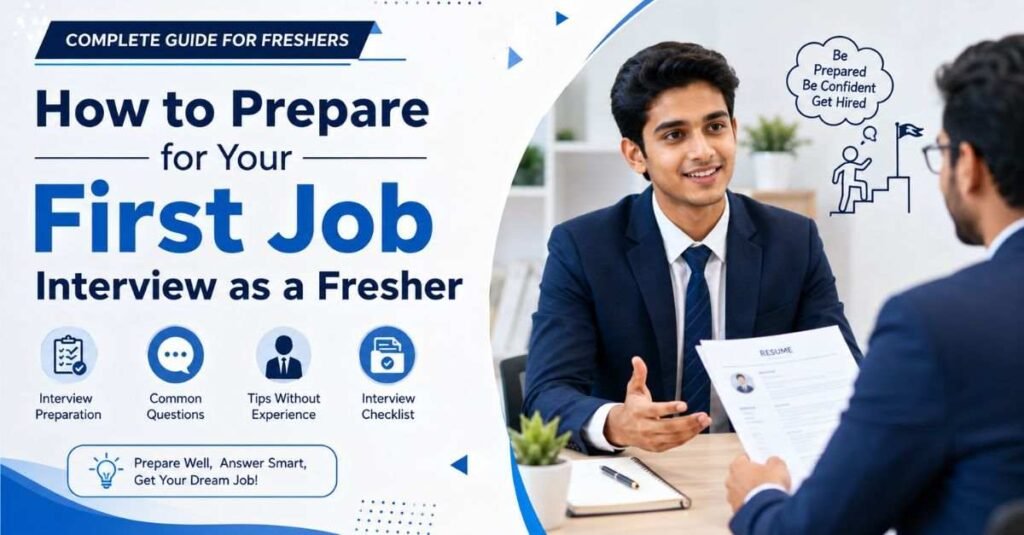
Your first job interview can feel exciting, confusing, and a little stressful—especially when you have no professional experience. You may wonder what to study, how to answer questions, or what recruiters expect from a fresher.
The good news is that you do not need years of experience to make a strong first impression. You need preparation, clear communication, basic knowledge of your field, and the confidence to explain what you can do.
Whether you are applying for an IT job, a non-technical role, an internship, or your first full-time position, this guide will help you prepare step by step.
What you will learn
Practical preparation tips to help you approach your first interview with confidence.
What to prepareCompany, role, resume, and subject knowledge.
How to answerCommon questions with simple answer strategies.
What to carryA practical interview checklist.
What to avoidCommon mistakes that can affect your impression.
Why Interview Preparation Matters for Freshers
A fresher interview is not only about answering technical questions. It is also an opportunity for the recruiter to understand your communication skills, attitude, learning ability, and interest in the role.
Good preparation helps you:
- Understand what the company is looking for.
- Explain your education, projects, and skills clearly.
- Reduce nervousness through practice.
- Answer questions in a more structured way.
- Show that you are serious about the opportunity.
- Ask thoughtful questions at the end of the interview.
Remember: The goal is not to memorise every possible answer. The goal is to understand your own strengths and communicate them naturally.
1. Understand the Job Role Before You Start Preparing
One of the most important First Job Interview Tips for Freshers is to understand the position you are applying for.
Read the job description carefully and identify:
- The job title and responsibilities.
- Required technical or professional skills.
- Educational qualifications.
- Any preferred experience or certifications.
- The tools, software, or knowledge mentioned.
- Whether the role is technical, non-technical, or customer-facing.
For example, if you are applying for a Software Developer role, you may need to revise programming fundamentals, databases, problem-solving, and your academic projects. For a Digital Marketing role, you may need to understand SEO basics, social media, content writing, and digital marketing concepts.
How to prepare from the job description
Create a simple table:
| Job requirement | What you know | What to revise |
|---|---|---|
| Programming basics | C, Java, or Python | Syntax and problem-solving |
| Communication skills | Presentations | Self-introduction |
| Project experience | College project | Project explanation |
| Teamwork | Group assignments | Examples of collaboration |
This helps you focus on what is relevant instead of trying to study everything.
2. Research the Company
Before attending an interview, spend some time learning about the company. You do not need to memorise its entire history, but you should know what it does and why you are interested in joining.
Check these details
- Company name and industry.
- Main products or services.
- Official website and career page.
- Recent business updates, if relevant.
- Company values or work culture.
- The department or team mentioned in the job description.
Why this matters
Recruiters may ask:
“Why do you want to join our company?”
A prepared answer shows that you have made an effort to understand the opportunity.
Example:
“I am interested in this role because it matches my skills in programming and problem-solving. I also like the opportunity to work on real projects and learn from an experienced team.”
Keep your answer genuine. Avoid saying that you want the job only because of salary or because the company is famous.
3. Prepare a Strong Self-Introduction
“Tell me about yourself” is one of the most common opening questions in a fresher interview.
A good introduction should be short, relevant, and easy to understand. You do not need to tell your entire life story.
A simple self-introduction structure
- Your name and educational background.
- Your relevant skills or area of interest.
- A project, internship, or achievement.
- Why you are interested in the role.
Sample answer for a fresher
“Good morning. My name is [Your Name], and I have recently completed my [Degree] from [College Name]. I have a strong interest in [Your Field], and I have developed skills in [Skill 1] and [Skill 2]. During my studies, I worked on a project related to [Project Topic], which helped me improve my practical knowledge. I am now looking for an opportunity where I can apply my skills, learn from experienced professionals, and contribute to the team.”
Tip: Practise your introduction several times, but do not memorise it word for word. Speak naturally.
4. Revise Your Resume Thoroughly
Your resume is one of the most important parts of your interview preparation. Recruiters often ask questions based on the information you have included.
Everything written on your resume should be something you can explain.
Review these sections
- Education and academic performance.
- Technical skills.
- Projects.
- Internships or training.
- Certifications.
- Achievements.
- Hobbies or interests, if included.
Be ready to explain your projects
For every project, prepare answers to these questions:
- What was the project about?
- Why did you choose it?
- What was your role?
- Which tools or technologies did you use?
- What challenges did you face?
- What did you learn?
- What would you improve in the future?
Example
If you mention a Python project, be prepared to explain the basic logic, the libraries you used, and how the project works. If you mention a web development project, understand the purpose of the application and your contribution to it.
Do not add skills only because they are popular. It is better to mention fewer skills that you understand well than many skills you cannot explain.
5. Focus on the Right Subject Knowledge
You do not need to become an expert before your first interview. However, you should revise the fundamentals related to your role.
For IT and software roles
Focus on:
- Programming fundamentals.
- Object-oriented programming basics.
- Data structures and algorithms.
- Database concepts and SQL.
- HTML, CSS, and JavaScript, if relevant.
- Operating system and networking basics.
- Your project technologies.
For non-technical roles
Focus on:
- Communication skills.
- Industry and company knowledge.
- Basic role-related concepts.
- Problem-solving and teamwork.
- Customer handling or business fundamentals, where relevant.
A better way to revise
Instead of only reading notes, try to explain each topic in your own words.
For example:
“What is a database?”
A simple answer:
“A database is an organised collection of data that can be stored, managed, and retrieved efficiently.”
If you can explain a concept simply, you are more likely to answer confidently during the interview.
6. Practise Common Interview Questions for Freshers
One of the most useful parts of Interview Preparation for Freshers is practising questions that recruiters frequently ask.
You should prepare for both general and role-specific questions.
Common HR questions
- Tell me about yourself.
- Why do you want to join our company?
- Why should we hire you?
- What are your strengths?
- What is your weakness?
- Where do you see yourself in five years?
- Are you comfortable working in a team?
- Are you willing to relocate?
- What are your salary expectations?
- Do you have any questions for us?
Common technical questions
These depend on the job role, but may include:
- Explain a project you worked on.
- What is the difference between a programming language and a framework?
- What is a database?
- What is OOP?
- What is the difference between HTML and CSS?
- Write a simple program to reverse a string.
- What is the difference between primary key and foreign key?
- Explain a concept mentioned in your resume.
How to practise effectively
Do not just read answers. Speak them aloud.
You can practise in front of a mirror, record your voice, or ask a friend to conduct a mock interview.
The aim is to improve clarity, not to sound perfect.
7. Learn How to Answer Questions Without Experience
Many freshers worry about questions such as:
“You do not have any work experience. Why should we hire you?”
This is where Interview Tips Without Experience become especially useful.
You can discuss:
- Academic projects.
- Internships or training.
- College assignments.
- Certifications.
- Personal projects.
- Volunteering.
- Team activities.
- Problem-solving experiences.
Example answer
“Although I do not have professional work experience yet, I have developed practical knowledge through my academic projects and training. I have worked on [Project Name], where I learned [Skill]. I am a quick learner, and I am eager to apply my knowledge in a professional environment.”
Remember
No experience does not mean no value. Your ability to learn, adapt, and take responsibility can also be important to an employer.
8. Prepare Answers Using the STAR Method
The STAR method is useful for answering behavioural questions in a structured way.
| Part | Meaning | What to explain |
|---|---|---|
| S | Situation | What was happening? |
| T | Task | What did you need to do? |
| A | Action | What steps did you take? |
| R | Result | What was the outcome? |
Example: “Tell me about a time you worked in a team.”
Situation: During my final-year project, I worked with a team of four students. Task: We needed to complete the project within a fixed deadline. Action: I helped divide the work, completed my assigned tasks, and supported my teammates when they faced difficulties. Result: We completed the project on time and improved our understanding of teamwork.
You can use examples from college. They do not have to come from a professional job.
9. Improve Your Communication Skills
You do not need to speak with a foreign accent or use complicated English to perform well in an interview.
What matters is that you can:
- Speak clearly.
- Explain your thoughts logically.
- Listen carefully.
- Answer the question directly.
- Ask for clarification when needed.
Simple communication tips
- Use short and clear sentences.
- Avoid unnecessary technical jargon.
- Do not rush your answers.
- Maintain a comfortable speaking pace.
- Take a moment to think before responding.
- Be polite and professional.
If you do not know an answer, you can say:
“I am not completely sure about that, but I would like to learn more about it.”
This is better than giving a random or misleading answer.
10. Practice Mock Interviews
A mock interview is one of the best ways to prepare for your first interview.
Ask a friend, mentor, teacher, or family member to conduct a practice interview.
During the mock interview, practise:
- Your self-introduction.
- HR questions.
- Technical questions.
- Project explanation.
- Questions about your resume.
- Asking questions at the end.
After the mock interview, review:
- Did you answer clearly?
- Did you speak too fast?
- Did you use too many filler words?
- Did you explain your projects confidently?
- Did you maintain professional body language?
- Did you answer the actual question?
Tip: Record your practice session if you are comfortable. Listening to yourself can help you identify areas for improvement.
11. Pay Attention to Body Language
Your communication is not only about words. Your body language also contributes to your overall impression.
During the interview
- Sit comfortably and maintain good posture.
- Make natural eye contact.
- Smile when appropriate.
- Avoid constantly looking at your phone.
- Listen without interrupting.
- Keep your hands relaxed.
- Show interest when the interviewer is speaking.
You do not need to act overly confident. Be calm, respectful, and attentive.
12. Prepare Your Interview Outfit and Documents
Preparing your clothes and documents in advance can reduce last-minute stress.
What to wear
Choose clean, neat, and comfortable formal or smart-casual clothing, depending on the company and role.
For example:
- A clean shirt or formal top.
- Trousers or suitable formal bottoms.
- Clean shoes.
- Minimal accessories.
- A professional appearance.
What to carry
- Updated resume.
- Educational documents, if requested.
- Certificates, if relevant.
- Pen and notebook.
- Interview invitation or details.
- A copy of the job description, if useful.
For online interviews, also check your camera, microphone, internet connection, and background.
13. Prepare for Online Interviews
Many companies conduct interviews through video calls. Treat an online interview with the same seriousness as an in-person interview.
Before the interview
- Test your microphone and camera.
- Check your internet connection.
- Choose a quiet place.
- Keep your background clean.
- Charge your laptop.
- Keep your resume nearby.
- Join the meeting a few minutes early.
During the interview
- Look towards the camera when speaking.
- Avoid unnecessary distractions.
- Keep your phone on silent.
- Listen carefully before answering.
- If the connection is unclear, politely ask the interviewer to repeat the question.
14. Prepare Questions to Ask the Interviewer
At the end of an interview, you may hear:
“Do you have any questions for us?”
This is your opportunity to show interest in the role.
Good questions to ask
- What would be the main responsibilities of this role?
- What skills are most important for success in this position?
- What does the learning or training process look like for freshers?
- How does the team support new employees?
- What would you expect from someone in this role during the first few months?
Avoid asking questions that are already clearly answered in the job description.
15. Avoid These Common Fresher Interview Mistakes
Even well-prepared candidates can make mistakes. Being aware of them can help you avoid unnecessary problems.
Common mistakes
- Arriving late or joining the meeting at the last moment.
- Not researching the company.
- Giving memorised answers without understanding them.
- Adding skills to your resume that you cannot explain.
- Speaking negatively about college, teachers, or previous experiences.
- Interrupting the interviewer.
- Saying “I do not know anything” instead of explaining what you do know.
- Asking only about salary and holidays.
- Forgetting to thank the interviewer.
A better approach
If you do not know something, be honest. If you make a mistake, correct yourself calmly. If you feel nervous, take a breath and continue.
One difficult answer does not automatically mean a failed interview.
16. What to Do After the Interview
Your preparation does not end when the interview is over.
Take a few minutes to review:
- Which questions were asked?
- Which answers went well?
- Which topics were difficult?
- What would you improve next time?
If the company has provided a formal follow-up process, follow it. You can also send a short, professional thank-you message if appropriate.
Example
Thank you for taking the time to speak with me today. I enjoyed learning more about the role and the team. I appreciate the opportunity and look forward to hearing from you.
17. A Simple 7-Day Interview Preparation Plan
If you have one week before your interview, this plan can help you prepare in a focused way.
| Day | Preparation task |
|---|---|
| Day 1 | Read the job description and research the company. |
| Day 2 | Review your resume and prepare your self-introduction. |
| Day 3 | Revise role-related technical or professional fundamentals. |
| Day 4 | Prepare common HR questions and project explanations. |
| Day 5 | Practise a mock interview and improve communication. |
| Day 6 | Revise weak areas and prepare questions for the interviewer. |
| Day 7 | Check documents, outfit, interview details, and rest properly. |
Important: You do not need to study for the entire day. Even a focused preparation session can be useful if you practise consistently.
18. Job Interview Checklist for Freshers
Use this checklist before leaving for your interview or joining an online meeting.
Before the interview
- Read the job description.
- Research the company.
- Review your resume.
- Prepare your self-introduction.
- Revise important role-related topics.
- Practise common interview questions.
- Prepare your project explanation.
- Conduct a mock interview.
- Prepare questions to ask.
- Check the interview time and location.
On the interview day
- Wear clean and suitable clothes.
- Carry your resume and required documents.
- Arrive early or join the meeting a few minutes before.
- Keep your phone on silent.
- Stay calm and listen carefully.
- Answer honestly and clearly.
- Thank the interviewer.
Final Thoughts
Preparing for your first job interview as a fresher is not about knowing everything. It is about understanding the role, revising the basics, practising your answers, and showing that you are ready to learn.
You may not have professional experience yet, but you can still demonstrate your potential through your projects, education, communication, and attitude.
Start preparing early, practise regularly, and focus on improving one thing at a time. Your first interview is not just a test—it is also a learning experience that can help you become more confident for future opportunities.
Career Dhundo: Your Guide to Job Opportunities and Career Growth
Looking for your first job, internship, or the next step in your career? Career Dhundo helps job seekers discover hiring opportunities and useful career guidance in one place.
From fresher jobs and IT company hiring to interview preparation and career tips, our goal is to make your job search easier and more informed.
Explore opportunities, improve your skills, and take the next step towards your career with Career Dhundo.
Frequently Asked Questions
1. How should a fresher prepare for their first job interview?
Understand the job role, research the company, revise relevant skills, practise common questions, and prepare your resume and self-introduction.
2. What are the most common interview questions for freshers?
“Tell me about yourself,” “Why should we hire you?”, “What are your strengths?”, and “Explain your project” are common examples.
3. How can I prepare for an interview without experience?
Use your academic projects, internships, certifications, and college activities to demonstrate your skills, learning ability, and teamwork.
4. What should I carry to my first interview?
Carry your updated resume, required documents, certificates if relevant, and a pen and notebook.
5. How can I reduce nervousness before an interview?
Practise your introduction, conduct mock interviews, prepare your documents early, and take a few deep breaths before starting.
6. What should I do if I do not know an interview answer?
Be honest, explain what you know, and show that you are willing to learn instead of guessing.
7. Should freshers ask questions at the end of an interview?
Yes. Ask relevant questions about the role, training, team, or expectations to show your interest.
I am a Jobs and Career Content Writer at Career Dhundo with around 4 years of experience in content writing and research. I write about hiring, job opportunities, recruitment and career-related topics, focusing on providing simple, clear and useful information for job seekers.